Digital home of Big K's Little Farm -
"For you were like sheep going astray, but have now returned to the Shepherd and Overseer of your souls." - 1 Peter 2:25
The Georgia DNR finalized the 2023 to 2024 deer season's regs on 25 MAY. For me, opening day for Firearms Season is 21 OCT and the season will end on 14 JAN 2024. I don't yet hunt with a bow or muzzleloader, so I won't be taking advantage of the earlier dates associated with those seasons. After looking over the seasons of other states, I've come to love the Georgia deer season.
This year my goals are fairly simple. Now that I have several of my rifle projects completed, it's time to put them into the field and go hunt some deer. The closer we get, the more excited I am.
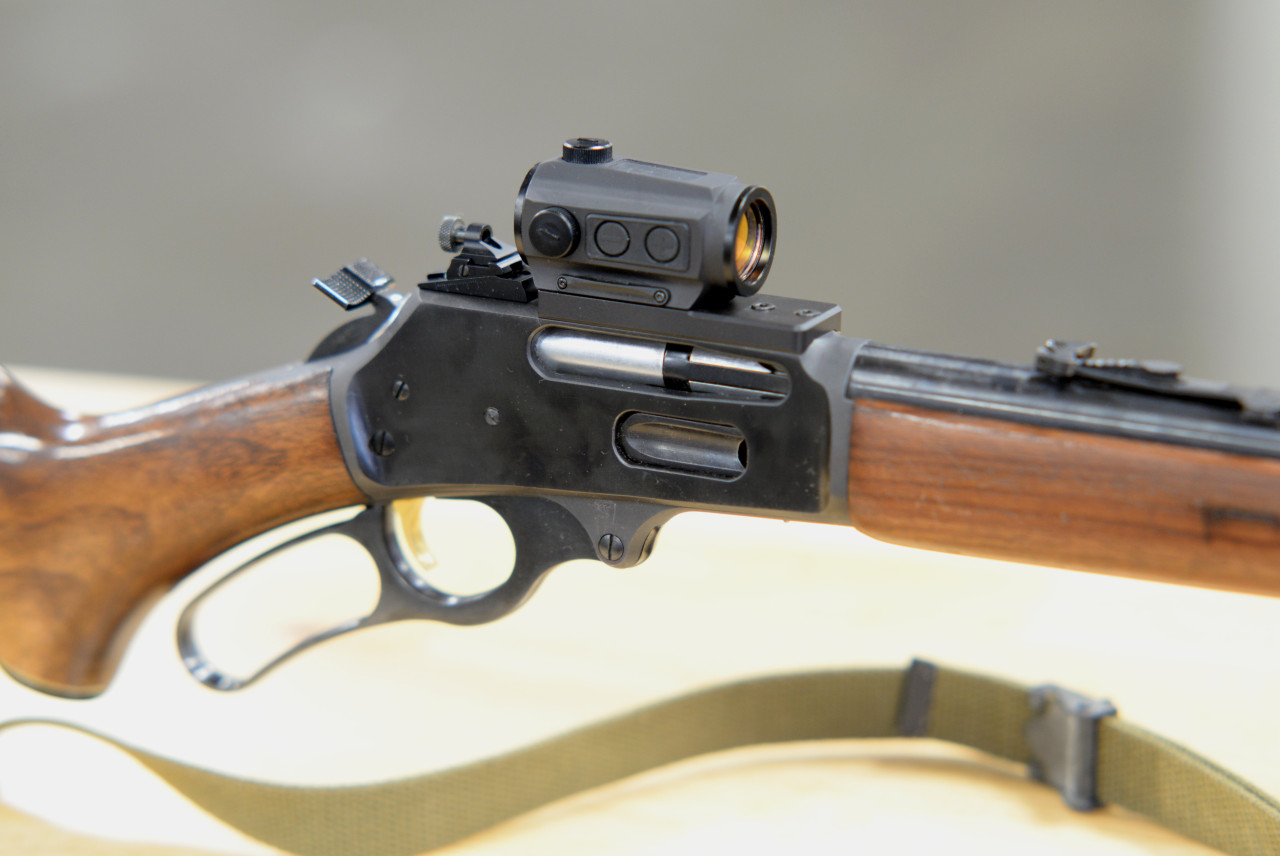
I stripped the Marlin 1894 CST in 357 Magnum of the Leupold 2.5x and reinstalled the Midwest Industries T1 Mount and iron sights putting the rifle back into the ProjectVaquero setup. I found that I very much like this layout but I don't know how I will like it in for deer hunting on the Farm. It should be good for 100 yards with the current setup. I had to re-zero but I wasn't setup for 100 yards so I zeroed at a shorter range that should match. Around 22 yards should be the first zero putting the second zero around 100 yards. It should be no more than 1.1 inches with the peak of the arc around 62 yards. The calculator puts my bullet down around 3 inches low at 133 yards. The calculated velocity of those Remington 158 grain semi-jacketed hollow points around 1300 fps at that point. That should be enough to achieve expansion.
The Marlin is my favorite Farm gun. It rides shotgun often.
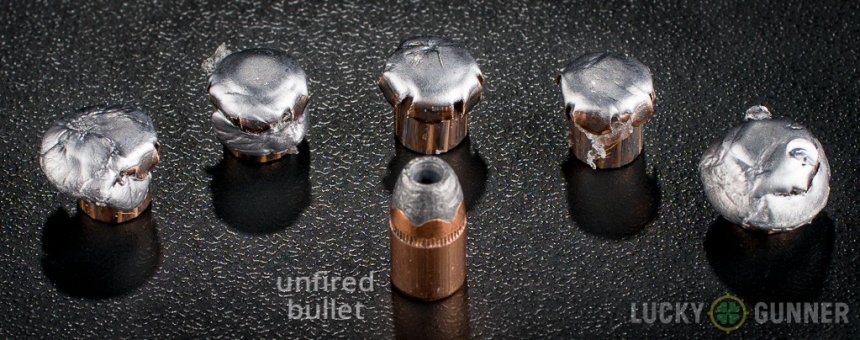
Speaking of expansion, every resource I have seen where people tested those Remington HTP rounds found that they expand to at least .50 caliber whether it's from a rifle or pistol. YouTube has various videos where someone tested those rounds from rifles and pistols in gel. Lucky Gunner did some testing as well. I have full confidence that those bullets will perform and penetrate deep enough. I picked up several boxes to keep in stock and plan to buy more. Much more.
Lucky Gunner posted this picture from their test. You can find it on their website in the Labs section. I can't thank those folks enough for their contribution to the firearms world. If you ever had questions about ammo selection, you should start there.
There doesn't appear to be a hard and fast rule on how far a bullet should penetrate ballistic gelatin for said load to be suitable for deer hunting but I've seen anecdotal data pointing to a preference of around 20 inches. Those HTPs appear to come close to that.
On the accuracy front, I've never really sat down to see what sort of groups I could get the Marlin 357 to do. Back in 2022, I zeroed the rifle with the setup I have now and was getting around 4 inch groups or so at 100 yards. I'm not much of a marksman and having no magnification won't help my case so I attribute that grouping to myself more than the gun. While I'd like to sit down and test again, I don't want to use the ammo up. I don't have sponsors to send me ammo when I need it.
If Remington ammunition wants to sponsor me, I will be happy to switch my other Farm Gun, the .300 Blackout, to their Core-Lokt line up and see how it goes in leu of the SIG Elite I currently use. I know the 30-30 Core-Lokt will kill deer since that's what I used until I had the Federal Fusion 170. I've still not gotten to use those Federal rounds to take a deer. On a side note, I'm not so sure these days that Marlin will release a threaded barrel version of the 336 and wood stocks that I can use as a dedicated hunting rifle. We'll see if the 336 project turns out. I have alternative plans if Marlin doesn't release a TB version of the 336.
Getting back to the topic of being majorly excited for deer season, once I get at least one deer, I'll start looking at taking the WWSD 300 Blackout build I put together and see it those SIG Elite all copper bullets work as advertised. That will depend on how the situation goes with the Marlin. I'm not as confident with just the red dot at shorter ranges as I am with a little magnification and I think I should try to get over that.
In conclusion, deer season cannot get here soon enough. I want to get out into the woods and find a good deer. Maybe this year will be my first buck.
Blocks on blocks. I've coined this term, I think, to refer to how people will put a picatinny rail on top of a rifle to attach a red dot using a generic mount. Simply put, the Picatinny Standard 1913 rail allows for a universal mounting point but it's very blocky and can lead to excess components when mounting certain aiming devices. I personally believe that a picatinny rail can ruin the aesthetic of a firearm quickly. On some guns, like the AR-15, the picatinny rail can give the rifle a great industrial or modern look but on something like a lever action rifle, you can lose the magic of the classic look very quickly. In the video below, you have a prime example of the phrase blocks on blocks.
There are better ways than slapping a picatinny rail onto of a rifle and ruining the aesthetic. As an example, in the above video, the red dot is probably about 2 inches over the bore. This is because Henry put a section of picatinny rail on top of the receiver for expediency. They probably just wanted to put a red dot on this particular rifle as a demo. Then they used the picatinny mount for the red dot. You have 2 layers of material on the rifle between the receiver and the red dot. By using a dedicated mount, you remove the extra and unnecessary layers of material saving height and weight.
While not that tall, there is still excess material between the red dot and receiver on this Ruger Lite
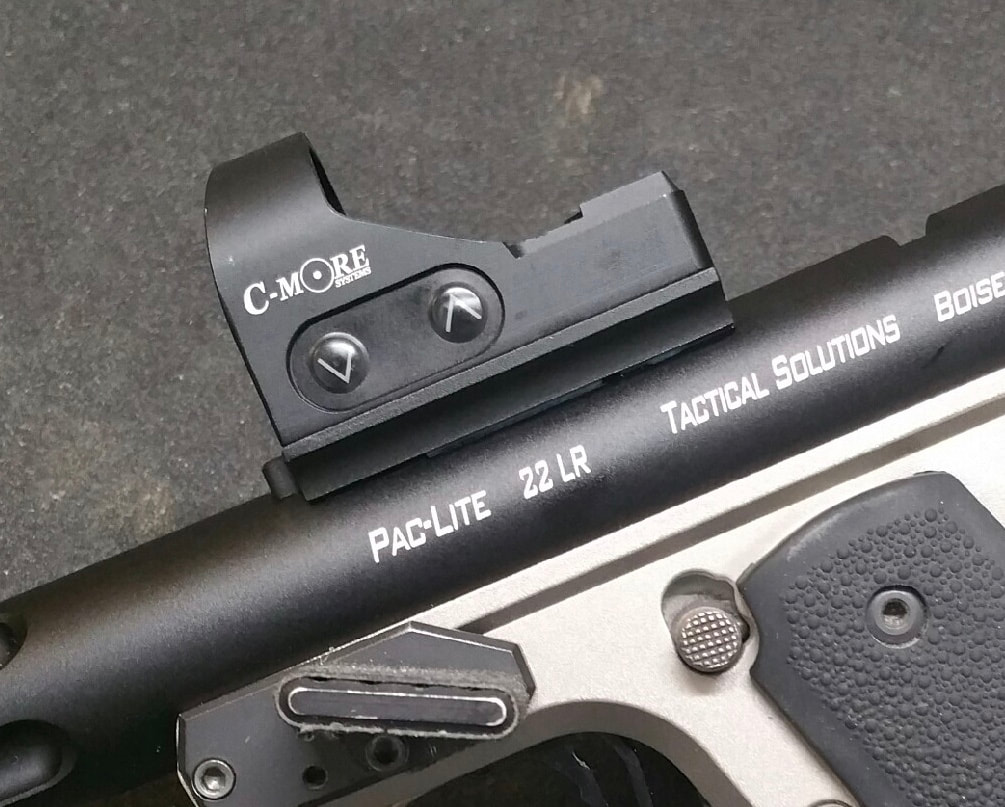
I had a mount similar to this MaddMac's mount on my MKIII Pac-Lite for a Vortex dot until the holes were stripped out. Then I moved back to the picatinny rail with some JB Weld.
To fix this excess materials issue, we can use a dedicated mount for the red dot we want to use. Many companies make dedicated mounts for popular red dots and popular firearms. If you spend some time on Google, you can find what you are looking for most likely. There are mounts for RMRs, Fastfires and even Aimpoint's Micro like the T1. This also applies to scopes. Here's a great example of a low profile, dedicated mount from Phoenix Weaponry. In the picture below, using this mount, the red dot is attached without the extra layer of the picatinny rail plus the mount for the red dot. You have the receiver, the mount then the dot.
Phoenix Weaponry's mount. They have others for Henry and Marlin PCCs.
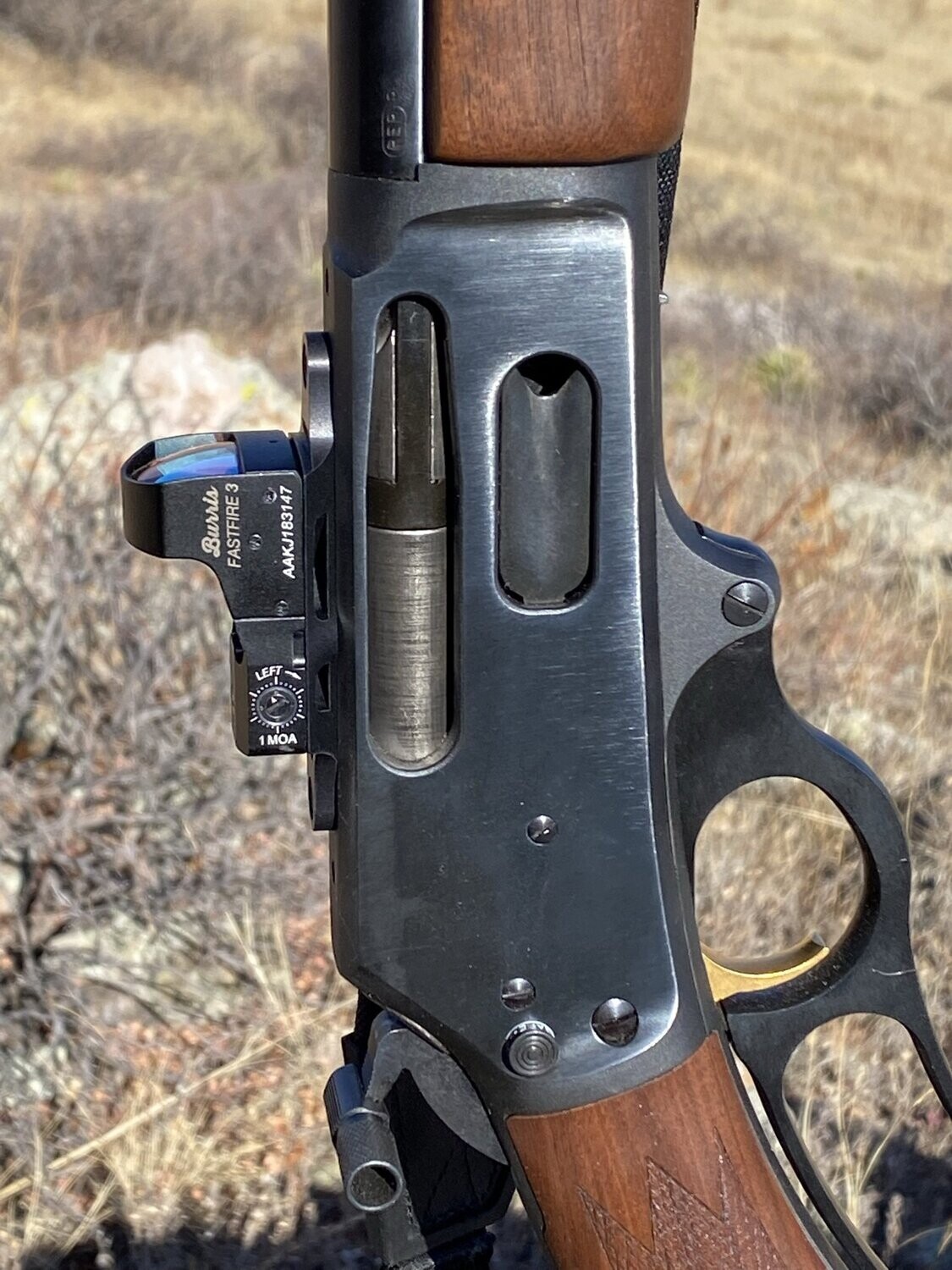
In the three pictures below, you can see the first, second and third iteration of my Marlin 1894. In the pictures, none of the mounts used are picatinny. The optics are using a dedicated mount for the specific optic deployed. First is the 336 mount for the Burris Fastfire 3. The second photo is of the SIG Romeo5 using the Midwest Industries T1 mount with integrated open sights. The third photo is the short-lived Leupold FX-II 2.5x scope with an Ashely Performance low profile scope mount for the 336 and 1895.
This is the initial version of the 1894 CST with the Burris 336 mount
This is the ProjectVaquero version of the 1894 CST with a MI T1 mount
Finally, this is the ProjectGranjero version which didn't last long as the scope went to the Homesteader
Depending on the situation, you can use the same mount for different guns if they have the same hole pattern. I used the Burris Fastfire 3 mount for the 336 and 1895 on my Marlin 1894 until Midwest Industries came out with their T1 mount. Then used that same 336 mount and Fastfire on the Henry Homesteader for a while. The Burris mount is for the 336 and 1895 rifles made by Marlin but because it only uses two of the holes, you're able to use the mount on either the front or the back pair of the scope holes. Since the distance between either pair of holes is the same (half inch), you can use the 2-hole mounts for the 336 and 1895 on the 1894 and Henry guns. The Weaver 63B mount pattern is what the 336 and 1895 use so many of those 2-hole mounts are compatible with the larger Henry receivers. That includes the likes of the Homesteader, the 45-70, 30-30 and 410 versions of their lever action guns. The smaller guns like the Big Boy rifles use a different, 3-hole pattern but the rear holes are still half inch. That will let you use the Burris mount if you wanted to use a Fastfire on your Henry BigBoy.
The Homesteader as stated above is capable of hosting the same 2-hole mounts as the Marlin 336 and 1895. In my case, the Burris 336 mount hosted the Fast Fire 3 for a while. It was very low profile and I think looks pretty good. It's clean and simple.
The Ashley Performance 1895 / 336 mount also fit nicely. I harvested the FX-II that was on ProjectGranjero for what I think will be a permanent installment on the Homesteader. I do suffer from a case of Can't Leave Things Alone so it's possible the Homesteader can change.
I had briefly considered using Farrow Tech's Red Dot Mounting Plate on the Homesteader and harvesting the SIG Romeo5 from the T1 mount. See the picture below where FT has their mount on Marlin. I'd be willing to bet, that mount would work for the 1894 since it only uses the front two holes.
Farrow Tech's Low Profile Mount for the Aimpoint footprint
The Henry Big Boy rifles use a three hole mount but looking at the rear pair of holes, they are around half inch apart which is the same as the 336 and similar. You should be able to use a 2-hole mount for a 336 (like that Burris mount) on a Big Boy.
In summary, you don't need to use picatinny rails on everything just to mount an optic. Use picatinny rails where it makes sense or at least looks good or if that's all you can use. If you look around, you can find mounts that you can use for your scopes and red dots to keep things low profile and clean.